
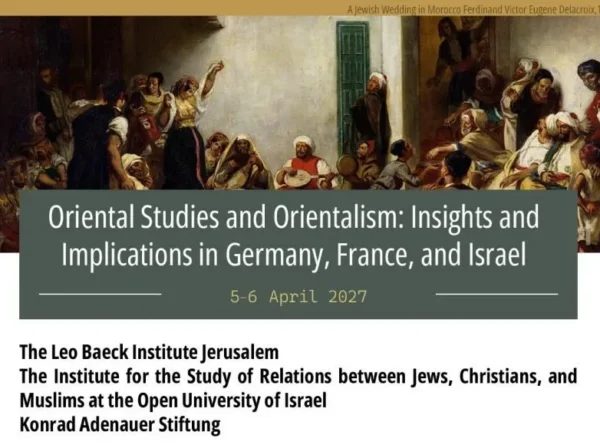
5-6 April 2027
The Leo Baeck Institute Jerusalem
The Institute for the Study of Relations between Jews, Christians, and Muslims at the Open University of Israel, Konrad Adenauer Stiftung
Edward Said’s Orientalism, published in 1978, sparked a major debate among scholars of the Middle East and Islam in Western academia. The debate was especially significant in Germany and France, where the study of Islam and the Middle East has a long and distinguished history, in which Jewish scholars made substantial contributions. For the first time, Orientalists themselves became subjects of scrutiny and critique. The scientific, objective, and neutral character attributed to their scholarship, as well as the reliability of their representations of the “Orient,” were critically questioned.
The debate shook the research field, followed by the emergence of postcolonial approaches that contend that, despite the end of formal colonial rule and the ensuing political independence of Arab societies, the legacy of Orientalism persists in Western cultural representations. These issues are particularly relevant in countries such as France and Germany, where significant populations have roots in regions previously subject to European colonial rule or influence.
Likewise, new scholarship suggests that European perceptions of Jews in the modern era, particularly in German and French cultural contexts, can be productively analyzed through Orientalist and postcolonial frameworks.
At the same time, academic scholarship has grown increasingly distant from the broader public sphere. While prejudices inherited from previous generations persist in public discourse, a new generation of Middle East scholars increasingly recognizes the need to critically reflect on cultural biases, scholarly positionality, and inherited analytical categories.
In light of these developments, we propose a research workshop that aims not merely to dwell on the debate surrounding Said’s work, but to revisit Orientalism from three main perspectives:
The first perspective will revisit Said’s original argument and consider whether his central claims were rather too generalizing to the extent they may have obscured significant differences among scholars of Islam and the Middle East in France, Germany, and Israel, thereby producing an overly uniform image of the field and its practitioners. This perspective will address questions such as, to what extent was Said’s critique applicable to Jewish Orientalists who played a formative role in the discipline’s development? Did Jewish scholars shape particular themes, methodologies, or fields of inquiry in ways that differed from their colleagues?
The second perspective will assess the current state of the study of the Middle East and Islam, as well as Jewish historical scholarship, in relation to the critical argumentation of Orientalism. Does this critique, however justified, entail the mistaken belief that scholars cannot legitimately study societies to which they do not belong? To what extent has the field internalized a reflexive awareness of its own assumptions and methodologies? Has the discipline reconciled with the controversy invoked by Said’s critique, or has the strife between supporters and critics of his approach in Germany, France, and Israel prevailed?
The third perspective will address future trajectories and the expectation, as it is implicit in Said’s work, to destabilize the binary categories of “East” and “West.” Are “East” and “West” now understood as more deeply entangled than earlier scholarly and cultural categories allowed? What roles might German, French, and Israeli academic institutions play in rethinking these categories and developing more nuanced approaches to cultural and historical encounters?
The workshop will be held in English on 5–6 April 2027 in Raanana and Jerusalem. Participation will be limited to researchers.
Travel and accommodation expenses will be covered by the organizers.
Applicants are invited to submit a curriculum vitae and a cover letter outlining their current research and explaining its relevance to the workshop.
Applications should be sent to: Leobaeck@leobaeck.org
The application deadline is 15 January 2027.
Applicants will be notified by 15 February 2027.